Here’s a stat that should stop any marketing lead mid-scroll: adding an explainer video to a landing page can lift conversion rates by up to 80%. Another one — 87% of marketers report a direct sales increase after using explainer videos, and 97% of businesses say it improved how customers understand their product.
If your funnel still relies on walls of text and static screenshots in 2026, you’re not just losing attention — you’re losing revenue.
This guide breaks down exactly how 2D explainer video animation services for businesses work, why they outperform almost every other content format on conversions, and what to look for when you’re ready to hire a studio. No fluff, no jargon. Just the playbook.
Why 2D Explainer Videos Have Become the #1 Conversion Format in 2026
A few numbers to frame the conversation:
- 95% of marketers say video is essential to their strategy.
- 73% of marketers report explainer videos as their primary video marketing tactic.
- 95% of consumers have watched an explainer video to learn about a business.
- 90% of customers say they make purchasing decisions faster after watching a product video.
- Websites with video are 53 times more likely to land on Google’s first page.
The pattern is unmistakable. When buyers are evaluating a product — especially in SaaS, fintech, healthcare, edtech, and ecommerce — they want a short, visual answer to a simple question: what does this do and why should I care?
That’s exactly what a 2D explainer video delivers. In 60 to 90 seconds, you can do what three landing pages and a white paper used to.
What Exactly Is a 2D Explainer Video Animation?
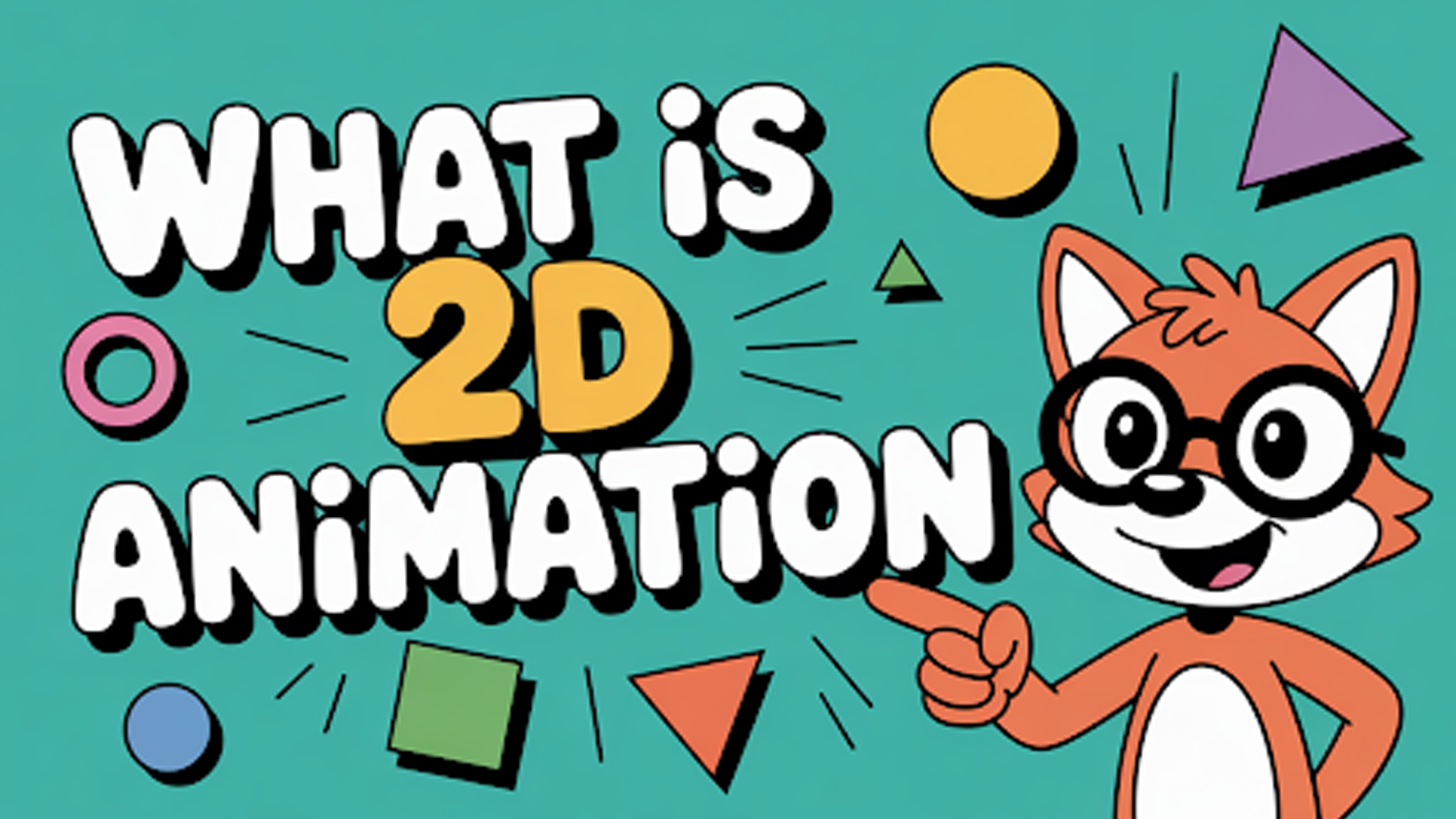
A 2D explainer video is a short animated piece — usually 60 to 90 seconds — that introduces a product, service, or concept using flat (two-dimensional) characters, illustrations, motion graphics, or a mix of all three.
It typically combines five elements:
- A script built around a clear problem-solution-benefit structure.
- A storyboard that maps the narrative scene by scene.
- Custom 2D animation — characters, illustrations, icons, and motion.
- A voiceover that matches your brand tone and audience.
- Sound design and music that reinforce pacing and emotion.
Within the 2D umbrella, common styles include character-driven animation, motion graphics, whiteboard animation, cel animation, and hybrid styles that mix multiple techniques. The right style depends on your audience, brand personality, and where the video will live in your funnel.
The Psychology Behind Why 2D Explainer Videos Convert So Well
Three behavioral patterns explain the conversion lift:
The Brain Loves Motion
The human brain processes visual information roughly 60,000 times faster than text. Motion adds a second layer — our visual cortex is hardwired to track moving objects. That’s why a 2D animated explainer holds attention longer than a static page, even if both deliver the same information.
Stories Beat Facts
Industry research shows that animations built around relatable characters and clear narrative arcs improve viewer retention by up to 65% compared to purely informational content. Buyers don’t remember bullet points. They remember the story of someone like them solving a problem.
Repetition Without Reading Fatigue
People will re-watch a 90-second animated video multiple times on mobile. They almost never re-read the same paragraph of text. For complex products, this re-watch behavior shortens the path to purchase — viewers absorb features at their own pace without skimming or bouncing.
6 Business Use Cases Where 2D Explainer Videos Drive the Most ROI
Not every product needs animation, but these six scenarios are where 2D explainers consistently outperform other formats.
1. SaaS Product Launches and Demos
If your product lives inside a dashboard, screenshots only get you so far. A 2D animated walkthrough can show value, workflows, and outcomes faster than any UI demo. This is the most common use case for 2D animated marketing video services for SaaS brands today.
2. Healthcare and Patient Education
From explaining a procedure to walking patients through medication regimens, 2D medical animations simplify complex science and improve consent and adherence rates. They also reduce repeated calls to clinical staff.
3. Fintech Onboarding and Compliance
Account creation, KYC flows, and policy explanations are notorious for drop-off. A short 2D explainer embedded at the right point in the funnel can lift completion rates and reduce confused support tickets.
4. E-commerce Product Demonstrations
For products that need a “how it works” moment — kitchen gadgets, beauty tools, software-enabled hardware — 2D explainers shorten the path from interest to checkout.
5. Edtech Course Previews and Lesson Intros
Animation increases learner comprehension for online education. Sales pages with 2D explainer videos for courses see noticeably higher enrollment.
6. Internal Training and Corporate Onboarding
2D animated training videos cost a fraction of live-action production and scale infinitely. New hires retain more, and HR teams stop running the same orientation session every month.
Anatomy of a High-Converting 2D Explainer Video
Every great explainer hits the same five beats. Miss one, and conversion drops.
1. Hook (0–5 seconds). Open with the problem your viewer feels in their bones. No logo intros. No “Welcome to ___.” Get to the pain immediately.
2. Problem framing (5–20 seconds). Make the viewer think, “this is exactly my situation.” Specificity beats generality.
3. Solution reveal (20–50 seconds). Show how your product solves the problem. Focus on outcomes, not features. Don’t describe the dashboard — describe the result.
4. Benefits and social proof (50–75 seconds). Layer in the top two or three benefits. Drop in customer logos, a stat, or a quick testimonial if relevant.
5. Call to action (75–90 seconds). One clear next step. “Start free trial.” “Book a demo.” “Get a quote.” Don’t muddy it with three options.
Total runtime: 60 to 90 seconds. Longer videos see steep drop-off — most viewers disengage past the 90-second mark unless the content is highly entertaining.
What Custom 2D Animation Studios Actually Do Differently
There’s a meaningful gap between template-based explainer factories and a custom 2D animation studio for explainer videos. Here’s what separates them.
- Strategy-first discovery. Custom studios start with audience, funnel placement, and conversion goals — not style preferences.
- Original scripts. Not Mad Libs templates with your product name swapped in. Real scripts written for your specific buyer persona.
- Hand-illustrated characters and scenes. Brand-aligned art, not stock libraries.
- Custom storyboards reviewed before animation begins. Saves rework and reduces revision cycles.
- Sound design built for your brand tone. Not the same royalty-free track every competitor uses.
- Performance tracking after launch. A real partner asks about results 30 and 60 days post-launch — and iterates if needed.
The cost gap is real (custom usually runs 2–4x template work), but so is the conversion gap.
How to Hire 2D Animators for Explainer Videos Online
In 2026, you don’t need a local studio — you need a structured remote process. When you set out to hire 2D animators for explainer videos online, vet against these five criteria.
1. Vertical-Specific Portfolio
Don’t just look for “nice 2D work.” Look for 2D explainers shipped for businesses that look like yours. SaaS, healthcare, fintech, ecommerce — match the niche.
2. Case Studies with Outcomes
Anyone can show a portfolio reel. The studios worth hiring publish case studies with measurable outcomes — conversion lift, view-through rate, demo bookings.
3. Process Documentation
Ask for their production pipeline in writing. A serious high-quality 2D animation production company in USA or anywhere else will share their kickoff, script, storyboard, animation, sound, and delivery phases with timing for each.
4. Contract Clarity
Before you sign, confirm: revision rounds, ownership of source files, usage rights, payment milestones, and what happens if scope changes mid-project.
5. References You Can Actually Talk To
Ask for two clients you can call. The studios with happy clients will connect you in 24 hours. The ones that hedge are the ones to skip.
What 2D Explainer Video Animation Services Cost in 2026
Pricing varies based on script complexity, number of characters, scene count, voiceover quality, sound design, and revisions. Rough 2026 ranges for a 60-second 2D explainer:
- Template-based / DIY platforms: $200 – $1,500
- Mid-tier custom 2D: $3,000 – $8,000
- Premium custom 2D with original characters: $8,000 – $20,000
- Broadcast-grade 2D with celebrity voiceover and high-end sound: $20,000 – $50,000+
The biggest mistake brands make is comparing quotes on headline price instead of scope. A $3,500 quote that excludes voiceover, music licensing, sound design, and revisions can easily land above a $9,000 all-inclusive quote once everything is added.
For professional 2D animation services for business growth, most established mid-market brands sit comfortably in the $8,000–$20,000 range for a 60–90 second piece.
Common Mistakes That Kill 2D Explainer Video Performance
After watching thousands of explainer videos underperform, the same patterns keep showing up:
- Running too long. Past 90 seconds, completion rates collapse. Discipline the script.
- Burying the value prop. If a viewer doesn’t know what you do by the 15-second mark, they’re gone.
- Generic voiceover. A flat, AI-narrator-sounding voice destroys credibility. Cast for tone match.
- No call to action. A beautiful video that ends with just a logo is wasted spend.
- Wrong placement. A 90-second explainer on a paid social ad will lose 80% of viewers. Cut it to 15–30 seconds for that channel.
- Skipping the storyboard review. Brands that approve animation without reviewing the storyboard regret it during the revision phase.
Frequently Asked Questions
How long should a 2D explainer video be?
The sweet spot is 60 to 90 seconds. Long enough to communicate problem, solution, and benefits — short enough to hold attention through the call to action. For paid social ads, cut down to 15–30 seconds.
Do 2D explainer videos work for B2B businesses?
Yes — arguably better than for B2C. B2B buyers face longer evaluation cycles and need to simplify complex value propositions internally. A 2D explainer becomes a sales asset that travels through procurement, IT review, and leadership approval.
What’s the typical production timeline?
For a 60–90 second custom 2D explainer, expect 4 to 8 weeks from signed brief to final delivery. Faster turnarounds are possible but usually involve creative compromises or rush fees.
Should I write the script myself or let the studio handle it?
Most established studios include scripting in the package. You’re better off providing a brief on audience, pain points, and desired outcomes — then letting professional copywriters draft. Brands that write their own scripts almost always over-explain features and bury benefits.
Can a 2D explainer video improve SEO?
Indirectly, yes. Pages with embedded video typically see longer dwell time and lower bounce rates, both of which are positive ranking signals. Adding video transcripts and schema markup amplifies the SEO benefit further.
How do I know if my 2D explainer is actually working?
Track these metrics 30 and 60 days post-launch: conversion lift on the host page, video completion rate, click-through on the embedded CTA, and any change in qualified lead volume. If completion rate is under 50%, the script is likely too long.
Final Thought
A 2D explainer video isn’t a creative side project. In 2026, it’s one of the highest-leverage assets your funnel can have — and the studios that combine sharp strategy, original creative, and disciplined production are the ones quietly driving the conversion lifts the rest of the industry is still chasing.
Get the brief right. Pick the studio carefully. Measure the outcome. That’s how high-impact 2D animation actually pays for itself.